Showing posts with label Henry Starr. Show all posts

Friday, March 7, 2014

Not Every Good Deed Goes Unpunished

by Phil Truman

Crawford "Cherokee Bill" Goldsby
It could be said, the only good thing Crawford Goldsby did in his short, miserable existence was to aid a fellow inmate in getting a presidential pardon.

Maybe in today’s society some folks would say he didn’t have much of a chance in life, but I’ve always felt one’s personal destiny is a matter of choice, not chance. Some contemporaries of Goldsby, men with perhaps even worse starts in life, stand as shining examples of rising to personal greatness by choice: Bass Reeves, Quanah Parker, George Washington Carver come to mind.

Crawford was born in 1876 to mixed race parents. His father, an ex-slave from Alabama, was a Buffalo Soldier with the 10th Cavalry in Texas. His mother was a Cherokee “freedman” with Indian, African, and European ancestry. Early in his childhood Crawford’s parents split-up, and his mother moved to Fort Gibson, IT. The boy was sent off to “Indian schools” in Kansas and Carlisle, Pennsylvania, but formal education didn’t take with him, and he returned to Fort Gibson. The rest of his short life he remained functionally illiterate.

At age twelve, Crawford killed his first man. In an argument over doing some chores, the boy grabbed a gun and shot his brother-in-law, although he was never prosecuted due to his age. Having already committed murder, Crawford didn’t have anywhere to go but down, so he fell in with a bad crowd, started drinking, and actively took up the life of an outlaw.

By the time he was eighteen, Goldsby shot another man, and joined up with the notorious Cook brothers, Jim and Bill, running whiskey into Indian Territory, which was, of course, illegal. After recruiting other outlaws into their gang (one of whom was the young rookie outlaw Henry Starr), the Cooks and Goldsby, who by then had acquired the moniker “Cherokee Bill,” advanced their outlawry into bank and other armed robbery with a ruthless touch—shooting anyone they felt like.

While still eighteen Goldsby, a.k.a. Cherokee Bill, shot and killed his second brother-in-law, this one in the back. By then he also had another killing to his credit, a lawman who’d been part of a posse chasing the Cooks and Goldsby.

The coldblooded Cook Gang continued to terrorize eastern Indian Territory robbing mercantiles,
Cherokee Bill with some say the Cook gang, some say his captors
banks, trains, and depots. In one instance, while robbing a store in the town of Lenapah, an innocent passerby stuck his head in the door to see what was going on only to have Goldsby shoot him between the eyes.

The law finally caught up with Cherokee Bill in January, 1895 and shipped him off to the federal court and jail in Fort Smith, Arkansas whereupon his crimes--most notably the murders--got him convicted, and promptly sentenced to hang by Judge Isaac Parker. That’s where he did his one good deed in his life…sort of.

Cherokee Bill planned an escape from the infamous Fort Smith jail. It was a simple plan: to shoot his way out. He had an accomplice. History isn’t certain who, but he or she somehow snuck a pistol to the killer. The plan got as far as Bill killing one of the guards, then it became a standoff. That’s where Henry Starr came in. It so happened at the time he was in the jail, too, and because he and Goldsby had once been trail mates, Starr volunteered to try to disarm Bill. The deal was, he’d see if he could get the killer to give up, if the guards would promise to not shoot Bill afterward. Starr succeeded. They didn’t shoot Cherokee Bill that day, but they did hang him six months later, as appointed.

Several years later, when Starr was serving time in a federal prison in Ohio, the story of his heroic intervention at the Fort Smith jail with Cherokee Bill made it to President Theodore Roosevelt’s desk, and for his actions, the president gave Starr a pardon.
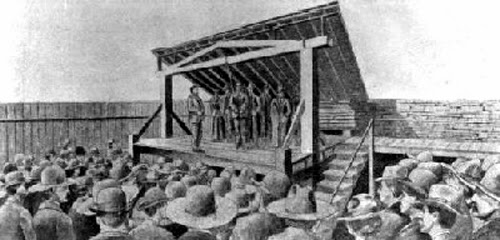
Fort Smith Gallows
The day twenty-year-old Crawford “Cherokee Bill” Goldsby stood at the gallows in Fort Smith, the U.S. Marshal asked him if he had any last words. Bill looked out at the crowd who usually gathered for these executions, and said, “I come here to die, not make a speech.” And he was then hung until dead.


You can read the fictionalized account of the Ft. Smith jailhouse meeting between Cherokee Bill and Henry Starr in Phil's award-winning novel,  Red Lands Outlaw, the Ballad of Henry Starr. Other novels by Truman include GAME, an American Novel, a sports inspirational about small town schoolboy football, and Legends of Tsalagee, a mystery/adventure in a small town. His western short story “Last Will for an Outlaw” appears in LaFrontera Publishing’s anthology, Dead or Alive, released June 2013. 
 
Phil’s website is: http://philtrumanink.com/  


Friday, February 7, 2014

An Outlaw's Day Off

by Phil Truman

Historical novels are a different kind of beast; you do your research, you write your book. Some facts you include, others you leave out, and the rest you make up to suit whatever story-telling goal you've got in mind. Then there are the bits you miss.

You call it a novel because there's a story you want to tell, an angle you want to reach thinking - hoping - the way you've put it down will reflect the illumination you're trying to achieve without corrupting the shine of the history you've set it in. But sometimes you miss things, sometimes things get by you.

1919 Movie Poster
So, after all the edits are made, the presses roll, the bookseller shelves are stocked (virtually or otherwise), you come across a little something you wish you'd been able to include. Such is the case with my book, Red Lands Outlaw, the Ballad of Henry Starr.

A friend of mine, Bill Woodard, a retired engineer at Phillips Petroleum and fellow Oklahoma history buff (check out an earlier post here: Frank Phillips--Cow Thieves and Outlaws Reunion), came across an obscure little piece about Henry Starr. It literally fell into his lap while he was doing some research on Western artist Joe De Yong, who grew up in Oklahoma and was a protege of Charles M. Russell.

Woodard was born in Dewey, Oklahoma, the small town neighbor of Bartlesville, where Phillips Petroleum was founded. Dewey holds a lot of western heritage (see Tom Mix Museum), and is the burial place of Henry Starr. So during his research on De Yong, Bill opened a book about Russell from his grandfather's library, and an old yellowed newspaper clipping fell out. It appears to be a column relating a pre-statehood vignette from one of Bartlesville's founders, a merchant named George Keeler, and his encounter with the outlaw Starr. I don't have the date of the column, nor the source. Bill figured it was most likely from the Bartlesville Examiner-Enterprise printed sometime in the late 1940's or
Bucking Horse-Joe De Yong
early '50's. With apologies to the author/publisher, here's the content:

In the early days, well before statehood, when there were only four or five businesses here [Bartlesville], no streets or sidewalks, no rural  highways and no banks, the business men would take their money to Caney, Kansas to bank [a distance of about 20 miles].

The story goes that one time Keeler had assembled some cash and was beginning to feel quite nervous. In those days this locality was the headquarters for a lot of bandits, among them the famous Henry Starr.

Keeler decided that he would saddle up and take off for Caney with the bank roll, for it began to look like that was the less desperate chance to take. As Keeler would tell it, he started up the trail toward Caney, hoping he would be lucky and not meet up with some of the bad boys and get relieved of the cash.

He had traveled about a fourth of the distance when he saw a man on horseback coming down the trail toward him, only a short distance away.

“When I got a little closer,” Keeler would relate, “I saw that it was the one whom I most feared to meet – Henry Starr himself.

The Oatlaw Henry Starr
“It was too late to run, for Starr always had one of the fastest mounts in the country, and he would be sure to overhaul me and take my money.

“So I put the spurs to my horse and came up to him plenty fast and said, ‘Henry, I sure am glad to see you. I thought for a moment it was someone who might rob me. Now I would like to get you to ride along and guard me up to Caney so that I can put this sack of money in the bank.’

“And, do you know, Starr took me up on the proposition and rode guard over me all the way to Caney. And I got every cent of the money in the bank."


I wish I could've used this story in my novel because it perfectly illustrates the picture I wanted to paint of Henry Starr - he was sure enough a thief and an outlaw, but he was no scoundrel.

You can read more about the life and times of Henry Starr in Phil Truman's award-winning novel,  Red Lands Outlaw, the Ballad of Henry Starr. Other novels by Truman include GAME, an American Novel, a sports inspirational about small town schoolboy football, and Legends of Tsalagee, a mystery/adventure in a small town. His western short story “Last Will for an Outlaw” appears in LaFrontera Publishing’s anthology, Dead or Alive, released June 2013. 
 
Phil’s website is: http://philtrumanink.com/  


Friday, October 4, 2013

Cow Thieves and Outlaws Reunion


Henry Starr did one thing in his life pretty well, he robbed banks.

The banker that morning in 1906 didn’t know about Starr when the young Cherokee, his hat in hand, approached his desk. “I’d like to hire some money, 'bout five hundred dollars,” Starr said.

The new bank in Bartlesville, I.T. (soon to be the new state of Oklahoma) hadn’t yet been open two months, and the bank officer, L.E. Phillips, was the right hand man and brother to bank owner, Frank Phillips. This handsome young fellow would be their first loan customer.

“What’s your name,” asked the banker.

“Henry Starr.”

“What do you do?"


“Oh, I work various jobs around here.”

“Do you have any collateral?”

Henry shifted his feet, and looked sideways. “I ain’t sure. What’s that?”

“It means do you have any property or goods to secure the loan…” L.E. Smiled. “In case you don’t pay it back.”

“Well, I got my horse and saddle…and my Henry rifle.” Starr could tell by the banker’s expression that wouldn’t be enough. “I reckon they’s a couple fellers here in town would stand by me for the money."

Sizing up the young man, L.E. decided he looked like a hard worker. Plus, the references he’d provided were reputable men in the community, so they filled out the papers and L.E. handed Henry the cash money.

Later that day, when brother Frank looked over the day’s transactions, he asked “You gave Henry Starr a loan?”

“Why, yes,” answered L.E. “Do you know him?”

“Only by reputation,” his brother answered. “He’s robbed several banks.”

The color left L.E.’s face and he grabbed the back of a chair to steady himself.

Frank laughed softly. “Don’t worry,” he said. “I believe he’ll pay it all back.”

And Henry Starr did, on time and with interest.

In his book Oil Man Michael Wallis said this about the Iowa farm boy turned barber turned banker
Frank Phillips
turned oil tycoon: “Frank Phillips [founder of Phillips Petroleum Company] was…a complete contradiction. It had to do with outlaws, real honest-to-goodness desperadoes. When it came to outlaws…the ramrod stiff banker and conservative businessman side of Frank Phillips melted like a cube of sugar in a cup of hot jamoke.”

The community of outlaws in those parts knew it, too, which gained him a certain amount of respect among the local banditti. They even extended to Frank Phillips that part of the brigands’ code about honor among thieves. No one ever robbed his bank, or stole one head of cattle off his ranch. It’s said many outlaws deposited cash money in the Phillips' bank, the source of such lucre being dubious. Most likely, much of it came from unlawful withdrawals from other area banks. Could’ve been Henry Starr borrowed that $500 to outfit an upcoming job. He was a thorough planner. But Frank believed in the frontier version of don’t ask, don’t tell. On the other hand, many owners of said robbed banks made out like bandits themselves by reporting to the insurance examiners two to three times the amounts actually stolen. So it was win-win-win.

Frank Phillips was enamored with the Old West and its ways. He loved outlaws and lawmen and cowboys and Indians and roughnecks and all such people and things. After his oil millions started pouring in he purchased land in the Osage hills of the I.T. putting in cattle and horses and buffalo to roam the 3,600 acres of prairie, hills, and woodlands. It became known as the FP Ranch, and later Woolaroc. He built a rustic lodge overlooking a spring-fed lake. The lodge became his personal retreat, as well as a place to entertain eastern business associates and celebrities he wanted to impress with western lore.

The Outlaw Henry Wells
The vast FP Ranch crossed into and butted up against the campgrounds and hide-outs for several local desperadoes like Al Spencer, Frank Nash, and Henry Wells. It’s said on more than one occasion Phillips would ride up to Wells’ cabin to spend a night playing poker with Wells and his group of shady characters.

Phillips even put Wells on his ranch payroll any time he had guests at the lodge, just to add an air of old west authenticity. One time when a group of easterners came to town, eager to experience the flavor of the “real” west, Phillips had a stage coach meet them at the train station to transport them to the ranch. A mile or so from the main gate, Wells and his mounted gang stopped the stage at gun point and robbed the passengers of every wallet, diamond stickpin, and watch fob. One or two of the party figured Phillips had staged the whole thing, but after Wells and his boys pushed some of them around a little, they weren’t rightly sure. When they got to the lodge, all a-bluster, they found their belongings on a table, and Wells and his gang out back drinking beer and laughing.

Phillips had a lot of company picnics and barbeques at the ranch, but he wanted to devise a way to salute all the outlaws and lawmen and cowboys, plus citizens of the Osage Nation where he'd drilled for oil. He headed up the formation of an association for all these tough guys, and in 1927 held the first of an annual gathering called the Cow Thieves and Outlaws Reunion.

About 100 “guests” attended the first Reunion, all by invitation, but in the years to come the guest list and crowd swelled to well over a thousand. Plenty of cow thieves and outlaws attended, but also
Osage Chief  Star That Travels, a.k.a. Bacon Rind
lawmen, politicians, celebrities and businessmen. It was colorful, to say the least. None were admitted without an invitation; however, Phillips left instructions at the gate to welcome in any American Legion boys in uniform, any cowboy on horseback, and any full-blooded Indians in "costume."

Reunion ground rules were simple: all guns, knives, and grudges had to be checked at the gate. After the festivities, the lawmen had to give the outlaws time to nurse their hang-overs and get a 24 hour head start.

The annual party that was started by “Uncle Frank” Phillips in 1927 continues to this day. It's hard to say how many cow thieves or outlaws show up nowadays as it’s an entertainment and dinner shindig for mainly Woolaroc Museum patrons. And most likely any veterans or regalia-clad Indians or mounted cowboys would still need to lay down the $75 price for a ticket at the gate to gain entrance. More than 900 attended last year, and they have big expectations for this year’s event. No doubt the spirit of Osage Chief Bacon Rind, the outlaw Henry Wells, and  Uncle Frank will be there, too. 


Phil Truman has authored three of what he calls, “Oklahoma-centric” novels.  Red Lands Outlaw, the Ballad of Henry Starra historical novel about the life and times of an Oklahoma outlaw, was a 2013 Peacemaker Award nominee and finalist for the 2013 Will Rogers Medallion for Western Fiction. His novel GAME, an American Novel is a sports inspirational about small town schoolboy football. Legends of Tsalagee weaves a tale of mystery and adventure in a small town. His western short story “Last Will for an Outlaw” appears in LaFrontera Publishing’s anthology, Dead or Alive, released June 2013. 

Phil’s website is: http://philtrumanink.com/


Thursday, April 4, 2013

Starrs in The Nations


Two questions seem to regularly come up about my novel Red Lands Outlaw, the Ballad of Henry Starr: How did I come to write about Henry Starr? Was he related to Belle Starr?

Henry Starr, 1919
The answers to both questions go back to the writing of my second novel Legends of Tsalagee, a mystery/adventure set in present day Oklahoma. The story revolves around the hunt for the Lost Treasure of Belle Starr, something I thought I’d invented. But when I started reading up on Belle for some of the back story, I discovered there actually is a legend about the outlaw stashing loot in a cave somewhere in eastern Oklahoma. So far as I know, that treasure hasn’t been found.

My Belle Starr research also led me, coincidentally, to Henry who was an accomplished and notorious Oklahoma outlaw in his own right, both in the I.T. and early statehood years. Amicable to a fault, Henry never wanted to hurt anybody or trouble them much, as long as they didn’t interfere with his business at hand, which was mainly robbing banks. His exploits fascinated me, so I decided a novel about this handsome, charming, and good-natured bandit would be a fun project. In Legends of Tsalagee I put him in as a minor character.

Belle Starr, 1887
Belle and Henry weren’t related; not by blood, anyway.  The widow Belle Reed, the former Myra Maybelle Shirley from Missouri, married Sam Starr, a Cherokee bad man. One of Sam’s seven brothers was George “Hop” Starr, Henry’s father. It’s said Henry didn’t much care for Belle, and hotly denied any kinship. That’s not surprising as Belle Starr was not the glamorous "outlaw queen" the entertainment world would later design. She was mean, ruthless, and brutal; maybe even cold-blooded. Belle was murdered, shot in the back two days short of her 41st birthday. The law never found her killer. My guess, it probably wasn’t a priority, although a long list of suspects existed, including her own son.

This excerpt is from Legends of Tsalagee. In the story Belle Starr’s son, Ed Reed, knew he’d be a prime suspect in his mother’s murder as he’d more than once publicly threatened to kill her. Paranoid with this knowledge, he’d split his ma’s stash of loot with his sister Pearl, and lit out with his half from the homestead at Younger’s Bend on the Canadian. He traveled northeast deep into the Cherokee Nation, I.T. Here, he comes face-to-face with young Henry Starr, a surly fourteen-year-old.

Ed heard the sound of a round being levered into the firing chamber of a Winchester, but the late afternoon sun came from the same direction, so he couldn’t see who held the rifle. He pulled up on his reins and lifted his left hand. His right hand slid cautiously toward the holstered Colt at his waist.

“Name’s Ed Reed,” he said loudly into the glaring sun. “I come up from around Eufaula looking for some of my ma’s kin.” 

Ed waited for several long seconds before he got a response.“Who’s your ma’s kin?” The voice sounded like that of a boy.

“She was married to Sam Starr. Her name is Belle Starr.”

More time slipped by in silence. Finally, the boy voice said, “Sam Starr was my uncle. I know who Belle Starr is, but she ain’t kin. She just married my uncle. I don’t like her much.”

“Well then, you’ll be happy to know she’s dead,” Ed said. “She was shot in the back and kilt yesterday. I had to hightail it out of there, because the sheriff is thinking I was the one who shot her.”

“Well, did ya?”

“Does it matter?” 

“Not to me, it don’t.” The boy walked around to the left side of Ed’s horse out of the sun’s glare. He pointed his rifle at Ed from about ten feet away. Ed took the boy to be about fourteen or fifteen.

“Your folks got a place around here?” Ed asked. He still kept his left hand in the air, and his right on his pistol handle. The boy didn’t say anything. He just kept his rifle leveled at Ed’s chest.

"’Cause I sure could use a hot meal. I been riding and pulling this mule since sunup. And I ain’t stopped to eat all day. My horse and mule could use a rest, too.” 

The silent stare continued from the boy. “Of course, I’d be willing to pay your folks for their trouble,” Ed added. He smiled trying to show he meant to be friendly.

“You got money?” the boy asked. 

The smile melted a little on Ed’s face and he moved his right hand back to grip his pistol. “Some,” he said. He was thinking he could slide off his horse to his right, draw his pistol, and fire at the boy under the horse’s neck. His horse might take a slug, but under the circumstances, it was his best chance. He was seconds away from putting that plan into action, when a man’s voice came from the trees.

“Henry!”


 Phil Truman has authored three of what he calls, “Oklahoma-centric” novels. His first, GAME, an American Novel is a sports inspirational about the intensity and weightiness of schoolboy football. Legends of Tsalagee weaves a tale of mystery, adventure, and romance in a small town. A #1 Bestselling Western on Amazon, Red Lands Outlaw, the Ballad of Henry Starr is Phil’s first foray into the western genre in this historical novel about the life and times of an Oklahoma outlaw. He has won numerous awards for his short fiction, and his western short story “Last Will for an Outlaw” will appear in LaFrontera’s anthology, Dead or Alive, due to be released June 2013.
Phil’s website is: http://philtrumanink.com/